
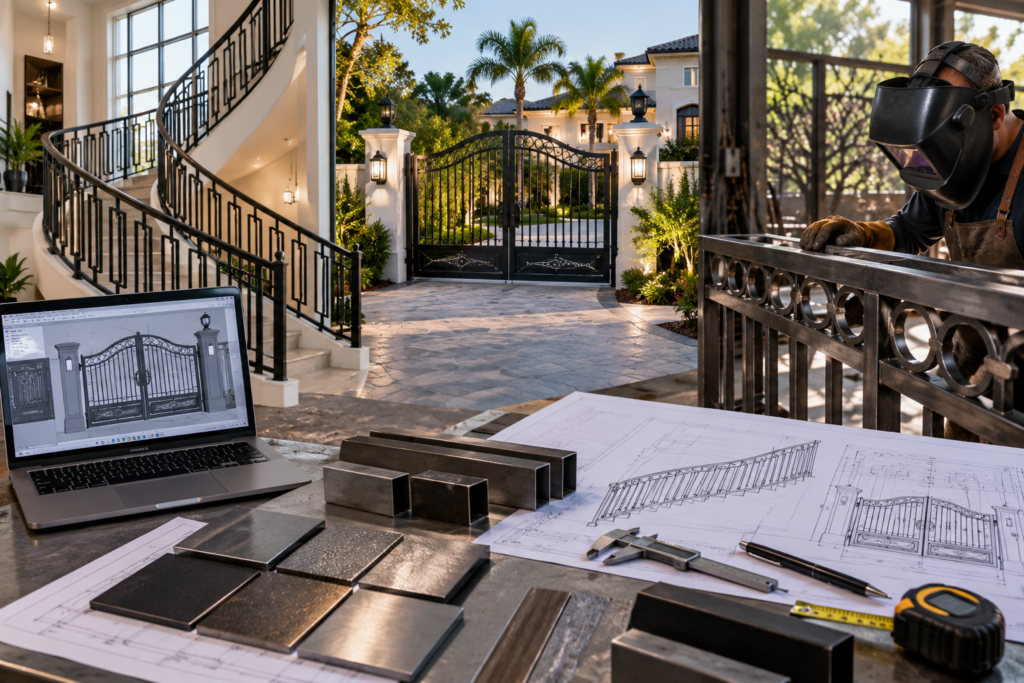
Metal fabrication design shapes nearly every outcome of a finished metal product: its strength, cost, appearance, and lifespan, because decisions made on the drawing board dictate how material behaves once it reaches the shop floor. Whether it’s a structural bracket, architectural metal fabrication for a building façade, custom metalworks for a client’s home, or a freestanding metal sculpture, the design phase decides success or failure.
A poorly planned bend radius can crack a panel mid-production. An overlooked weld sequence can warp an entire frame out of square. These aren’t rare mishaps; they’re predictable results of skipping proper design work, and they’re also entirely avoidable once you understand how design choices translate into fabrication outcomes.
Design Is the Foundation, Not an Afterthought
A persistent industry myth is that fabrication quality depends mostly on the skill of the person running the equipment. Skilled fabricators absolutely matter, but even the most experienced welder or machinist can’t fully compensate for a flawed metal fabrication design. If a part is drawn with unrealistic tolerances, awkward geometry, or a material mismatch for the intended process, problems will surface regardless of how experienced the team is.
Good design anticipates the entire fabrication journey cutting, forming, welding, finishing, and assembly and accounts for how the chosen metal will actually behave at each stage, not just how it looks in a CAD rendering.
Material Selection Shapes Everything Downstream
Choosing the right metal isn’t only about strength or budget; it directly affects how you can fabricate a design.
- Ductility and formability: Mild steel, aluminum, and stainless steel bend and form differently. A design that ignores a material’s minimum bend radius risks cracking or warping during forming, a common issue in custom metalworks where tight curves are part of the aesthetic.
- Thermal behavior: Welding introduces heat, and metals expand and contract at different rates. Designs that ignore heat-affected zones often end up warped or misaligned, especially in large-scale architectural metal fabrication projects where panel flatness matters.
- Corrosion resistance: If a piece, say, an outdoor metal sculpture, will face rain, humidity, or salt air, the design must specify a suitable alloy or protective coating from the outset, not as a patch after fabrication.
Tolerances and Precision Determine Cost and Feasibility
Every dimension on a drawing carries a tolerance, and tolerances have real financial consequences. Overly tight tolerances on non-critical features can drastically increase machining time, tooling demands, and inspection costs without adding real value to the finished piece.
On the other hand, tolerances that are too loose can cause parts to fit poorly during assembly, leading to rework, wasted material, or structural weak points. Strong metal fabrication design strikes a balance: precision where function genuinely demands it, and reasonable allowances everywhere else.
Geometry and Joint Design Influence Strength and Manufacturability
The shapes and joints specified in a design directly affect both structural integrity and ease of production.
- Sharp internal corners create stress concentrations, making a part more prone to cracking under load, a critical concern in load-bearing architectural metal fabrication.
- Complex bends or multiple flanges may require specialized tooling or extra setups, increasing lead time and cost, particularly for one-off custom metalwork pieces.
- Weld joint design butt joint, lap joint, or fillet weld affects strength and the amount of heat introduced, which in turn affects distortion and final appearance, especially visible on an exposed metal sculpture where welds can’t be hidden.
Designers who understand fabrication constraints can adjust geometry early, rather than leaving fabricators to solve avoidable problems later.
Design for Manufacturability (DFM) Reduces Waste and Rework
Design for Manufacturability asks a simple question: can this part actually be made efficiently and consistently? Applying DFM principles to metal fabrication design means considering:
- Standardizing hole sizes and hardware to reduce tooling changes
- Minimizing the number of unique parts in an assembly
- Designing nesting-friendly shapes to reduce material waste during cutting
- Avoiding features that require secondary operations unless truly necessary
A design built with manufacturability in mind moves through the shop faster, with fewer surprises and less scrap a principle that applies equally to industrial parts, architectural metal fabrication, and artistic custom metalworks.
Surface Finish and Aesthetic Requirements Start on the Drawing
If a piece needs a specific surface finish brushed, powder-coated, anodized, or polished that requirement should be built into the design from day one. Finish requirements influence material choice, weld placement (since welds often need grinding and blending), and even handling procedures during production to avoid scratches or contamination.
This is especially true for a metal sculpture or a decorative custom metalworks installation, where surface quality is often the entire point. Retrofitting finish requirements after fabrication is complete is far more expensive and rarely produces the same result as planning for them upfront.
Assembly and Functionality Considerations
A fabricated part rarely exists in isolation; it usually needs to fit with other components, withstand specific loads, or move in particular ways. Design decisions about mounting points, clearances, and load paths determine whether the final assembly performs as intended in the real world.
In architectural metal fabrication especially, poorly considered assembly features can lead to costly field modifications, misaligned panels, or structural issues under wind or seismic loads problems that are dramatically cheaper to solve on paper than after parts have already been cut and welded.
The Bottom Line
Metal fabrication design isn’t just a technical drawing handed off to a shop it’s the blueprint that determines nearly every outcome of the finished product: cost, strength, appearance, and longevity. Whether you’re commissioning architectural metal fabrication for a commercial build, ordering custom metalworks for a home renovation, or bringing a metal sculpture concept to life, investing time in thoughtful, manufacturability-conscious design pays off throughout the entire fabrication process.
Understanding how design choices affect fabrication outcomes helps you communicate more clearly with your fabricator and walk away with a better final part, faster and at lower cost.
Frequently Asked Questions
What is metal fabrication design, and why does it matter?
Metal fabrication design defines a part’s material, dimensions, tolerances, and joints before manufacturing. These early decisions directly shape the finished piece’s strength, cost, and manufacturability.
How is architectural metal fabrication design different from standard fabrication?
Architectural metal fabrication design must account for building codes, structural loads, weather exposure, and large-scale panel alignment, in addition to standard fabrication concerns like tolerances and joint strength.
Can poor design increase the cost of custom metalworks?
Yes. Overly tight tolerances, complex geometry, or unnecessary secondary operations can significantly raise the cost of custom metalworks without improving function or appearance.
Why does material choice matter so much for a metal sculpture?
A metal sculpture’s material affects how it forms, welds, and resists weathering. Choosing the wrong alloy can lead to cracking during fabrication or corrosion once installed outdoors.
What is Design for Manufacturability (DFM) in metal fabrication?
DFM is a design approach that simplifies parts, standardizes features, and reduces waste so you can fabricate a piece efficiently and consistently, minimizing rework and cost overruns.