
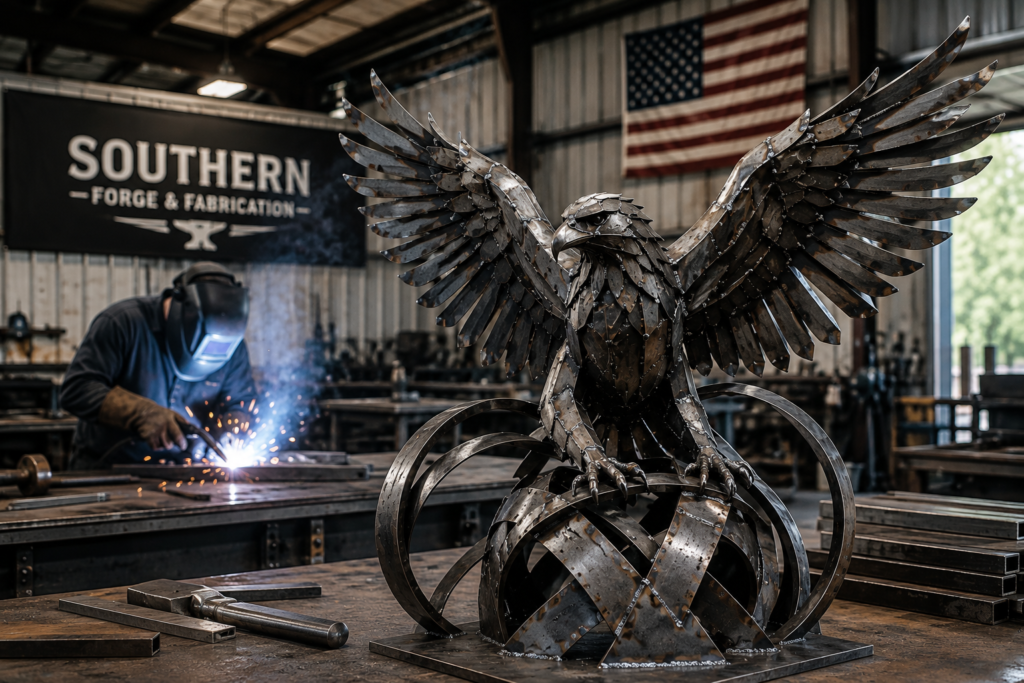
A welded metal sculpture is a three-dimensional artwork created by cutting, shaping, arranging, and permanently joining metal pieces through welding. Rather than carving a form from a single solid block, the artist builds it piece by piece from steel plate, rod, tubing, wire, stainless steel, aluminum, or reclaimed metal. Welding turns those parts into a single, strong structure, enabling everything from compact decorative pieces to large outdoor installations.
This art form combines creativity with fabrication. The artist considers shape, balance, texture, weight, stability, and how the finished work will look from different angles.
How Is a Welded Metal Sculpture Made?
1. Planning and Preparing the Design
The process usually begins with a concept, sketch, reference image, or small model. The artist decides how to divide the design into metal components. The artist may cut pieces from sheet metal, bend them from rod, form them from tubing, or select them from existing metal objects. Before welding, the artist positions the parts and checks their proportions.
2. Welding the Metal Components
The pieces are welded together. Gas metal arc welding, commonly known as GMAW or MIG welding, uses a continuously fed wire electrode and shielding gas to join metals. Flux-cored arc welding is another fabrication process that can suit heavier or high-productivity work. The method depends on the metal, thickness, and design.
3. Finishing the Sculpture
After welding, the artist may grind the joints smooth or keep visible weld marks as part of the artwork. The artist may then polish, paint, coat, patinate, or weather the surface.
What Metals Are Commonly Used in Metal Sculpture Art?
Mild steel is a common choice because it is strong, versatile, widely available, and suitable for many fabrication techniques. It can support geometric, organic, industrial, or textured designs. Stainless steel is often chosen for a refined or contemporary appearance, especially when a polished or reflective finish is wanted.
Aluminum provides a lighter option, while artists may add copper, bronze, or reclaimed metal for contrast. Material selection matters especially for large outdoor metal sculptures because artists and fabricators must consider weather, moisture, drainage, anchoring, maintenance, and appearance.
Why Is Welding Effective for Metal Sculpture?
- Creates strong, permanent connections: Welding gives artists durable joints without making bulky fasteners the main visual feature. This allows separate sections to read as one continuous form.
- Supports different scales and styles: A thin rod can create a delicate line drawing in space, while plate and structural sections can produce bold, monumental work. Artists can also develop curves, negative space, geometric patterns, and organic silhouettes through welding.
- Adds visual character: Visible welds can become part of the sculpture’s overall look. Some artists grind transitions until the surface appears seamless, while others retain weld beads and fabrication textures.
- Offers flexible finishing options: The final approach depends on whether the finished piece should feel polished, raw, industrial, architectural, or handcrafted.
Welded Sculpture vs. Cast Metal Sculpture
A welded sculpture is assembled from separate pieces that are cut, shaped, and joined. A cast sculpture is typically formed by pouring molten metal into a mold. Both methods can produce high-quality artwork, but they give the artist different ways to build form.
Welding lets you adjust the composition during fabrication. Artists can move, shorten, extend, or replace sections as the design develops. That flexibility works well for abstract sculpture, geometric installations, architectural artwork, and custom pieces made for a specific site. Casting often suits highly modeled forms, while welding naturally supports constructed shapes and open spaces.
Where Can Welded Metal Sculpture Be Used?
Welded sculpture works in both indoor and outdoor spaces. Indoors, it can become a focal point in homes, hotels, offices, restaurants, or commercial lobbies.
Outdoors, a large metal outdoor sculpture can enhance courtyards, gardens, corporate campuses, hotel entrances, and public landscapes. Sunlight, shadows, architecture, and landscaping influence its appearance.
Proper outdoor finishing, installation, and routine maintenance are important because corrosion can weaken metal over time.
What Makes a Large Metal Outdoor Sculpture Successful?
Size alone does not make outdoor art impressive. The sculpture should relate to the site and feel correctly scaled for its surroundings. Viewing distance, landscaping, architecture, lighting, pedestrian movement, and approach angles can all influence the design.
Structural planning matters too. Depending on scale and location, a large piece may require reinforcement, mounting plates, anchors, engineered bases, or foundations. Strong outdoor metal sculpture art feels connected to its setting. It can contrast with greenery, echo architecture, frame a view, or create a memorable focal point.
Can Welded Metal Sculpture Be Customized?
Yes. Customization is one of welded fabrication’s biggest strengths. A sculpture can be designed around a specific size, theme, location, architectural style, or visual idea. Possible directions include abstract forms, botanical designs, wildlife, geometric work, symbolic pieces, or site-specific installations.
Custom work also lets dimensions, base design, viewing height, finish, orientation, access, and installation conditions shape the design from the start. This makes custom artwork useful for architects, landscape designers, commercial property owners, and homeowners who want a piece created for a particular environment.
How Do You Care for a Metal Sculpture?
Maintenance depends on the material, finish, and location. Indoor pieces usually need gentle cleaning and occasional inspection. Outdoor work needs more attention because weather and environmental exposure can affect surfaces over time.
Owners should check painted or coated steel for chips, scratches, or early corrosion. Stainless steel may require periodic cleaning, while owners should maintain weathered finishes to match the intended appearance. For valuable or complex work, follow care guidance from the artist, fabricator, coating manufacturer, or qualified conservator.
Conclusion
A welded metal sculpture transforms separate metal components into a unified three-dimensional artwork through cutting, forming, welding, and finishing. Its appeal comes from combining artistic expression with durable fabrication, whether the project is a small interior feature or a large metal outdoor sculpture.
The final result depends on more than the welds. Material choice, proportion, structural planning, surface treatment, installation, and long-term care all influence how the work looks and performs. When these elements work together, metal becomes a flexible artistic medium that can add movement, identity, and lasting visual impact to a space.
Frequently Asked Questions
1. What is a welded metal sculpture made from?
Artists can make this artwork from mild steel, stainless steel, aluminum, rod, tubing, sheet metal, and selected reclaimed components. The best material depends on the design, scale, finish, and location.
2. Can a welded metal sculpture stay outdoors?
Yes. Design outdoor pieces with suitable materials, finishes, structural support, installation, and maintenance in mind.
3. How long does a metal sculpture last?
There is no single lifespan. Longevity depends on the metal, fabrication quality, exposure, coating, installation, and maintenance.
4. Is every welded sculpture handmade?
Many involve hands-on fabrication, although artists may also use digital design, CNC cutting, forming machinery, and other tools.
5. Can the artwork be made to a custom size?
Yes. Welded fabrication can scale from small decorative pieces to large site-specific installations, provided you consider structural, transportation, access, and anchoring requirements.